

Q4 Growth Planning That Protects Cash Through Q1
2026 has given you more opportunity than you expected. Maybe sales has earned a bigger target. Operations needs another hire. A promising customer is asking for more. Or maybe someone is proposing a new market.
Each request has a reasonable business case. Together, they may commit more cash and attention than the company can support, and that. is the decision a useful Q4 growth plan must resolve.
Which opportunities can you fund and deliver while keeping the business ready for Q1?
A revenue target alone cannot answer it. Your team needs to connect customer demand, cash timing, operating capacity, and ownership before approving the next investment.
Use these five checks to turn a list of growth ambitions into a practical 90-day plan.
1. Confirm the demand behind the growth
Begin with the customer behavior that supports your revenue assumptions. For example, a larger sales target needs evidence (repeat purchases, more qualified opportunities, existing customers placing larger orders).
You must separate committed business from likely business and speculative business. Then examine what must happen for each category to become revenue.
Does a customer need budget approval? Will a contract require a discount? Are you assuming a new salesperson will produce immediately?
These distinctions matter when spending starts ahead of the sale. Hiring to prepare for an unsigned contract commits the company before the customer has committed to you. Buying inventory for an optimistic forecast puts cash into products that may take longer to sell.
Choose the growth opportunity with the strongest combination of demand, margin, and fit. Make its assumptions visible to the whole leadership team. If the forecast depends on three uncertain events happening on schedule, your spending plan should reflect that uncertainty.
Ask your team: What customer evidence would justify this investment, and what evidence would make us reconsider?
2. Map when the cash leaves and returns
Revenue, profit, and cash describe different parts of the business. An order might look attractive on paper while requiring payroll, materials, and delivery costs well before the customer pays.
The Cash Conversion Cycle tracks the time required to turn inventory into collected cash, accounting for customer and supplier payment timing. Understanding that cycle helps leaders see how long funds are tied up in the business.
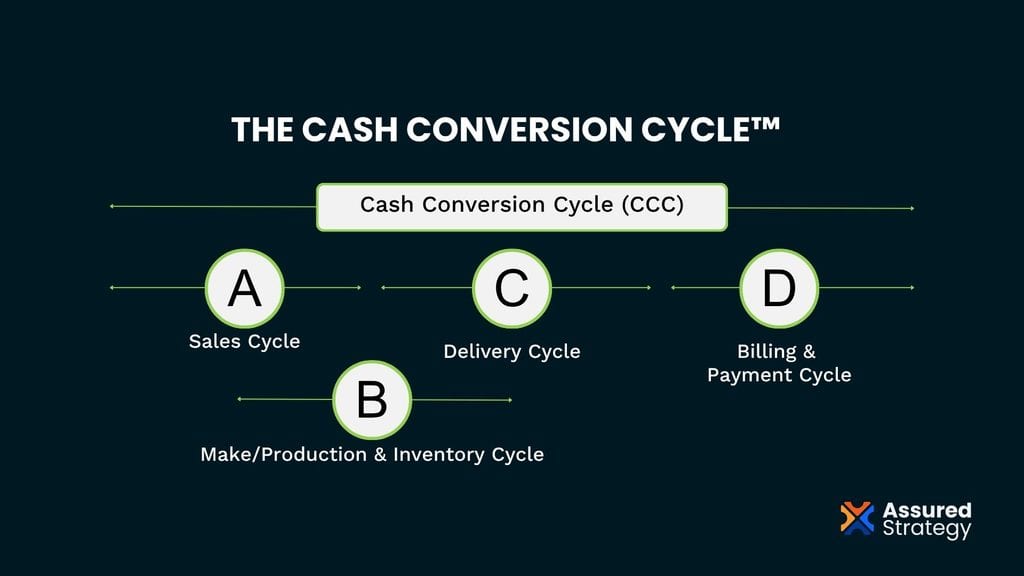
For each growth initiative, map the expected cash outflows and receipts by date. Include the spending required to secure the sale, fulfill it, invoice accurately, and collect payment. Use customers’ actual payment behavior when estimating receipts.
Consider a hypothetical company that must spend $60,000 on materials and labor in November to deliver a $100,000 order in December. If payment arrives in February, the company must fund the gap while paying its ordinary expenses. The order may be worthwhile, but the December revenue figure does not show the full cash requirement.
Build a rolling weekly cash forecast alongside your quarterly plan. Assured Strategy recommends a 36-month forecast updated each week to improve near-term cash visibility.
Yes, 36 months. Updated weekly. Every week.
This time of year, it’s helpful to extend your planning view into Q1 so January obligations and potentially delayed collections remain visible as you approve Q4 spending.
3. Find the capacity constraint before adding work
A growth plan can be both financially plausible and operationally unrealistic. Your team may have enough people overall while lacking capacity at the exact point where new work must pass through the business.
So trace the proposed growth from sale to collection.
Where will additional volume create a queue? It might be estimating, scheduling, production, approvals, quality control, or billing. In a service business, the constraint may be a senior employee whose judgment is required on every project.
Look at workload, turnaround time, rework, and responsibilities before deciding that another hire solves the problem. If work waits for the owner to approve routine decisions, adding staff may increase the approval queue. If invoices stall because completion records are inconsistent, more sales can expand the billing backlog.
Then match the response to the constraint. That might mean clarifying decision authority, simplifying an offering, improving a handoff, training a backup, or adding capacity in one specific role.
Finally, identify what will be deferred or removed to make room. A 90-day plan should account for the work your people already carry. Keeping every existing priority while adding new ones leaves the tradeoffs unresolved.
Ask your team: Which step will limit this growth first, and what must change before we increase volume?
4. Give the priority an owner and a meaningful measure
Once you choose your growth path, define the result in terms your team can manage.
“Grow sales” leaves too much open. A useful priority states the customer opportunity, the intended outcome, the deadline, and the leader accountable for coordinating the work.
Name one owner who can bring the relevant functions together and surface decisions promptly. Sales, operations, and finance may each contribute, but someone must keep the overall result visible.
Choose one critical number that reflects the main constraint. If delayed collection threatens the plan, overdue receivables may deserve special attention. If delivery capacity is the issue, backlog age or on-time completion may be more useful.
Define the target, the data source, and how often it will be reviewed.
Review progress in a short weekly leadership meeting. Ask what changed, whether the assumptions still hold, and which decision needs to happen now. That rhythm gives the owner a practical way to act before a missed target becomes a quarter-end surprise.
5. Set the rule for stopping or adjusting
Decide in advance what would cause you to slow spending, revise the offer, or pause the initiative. Teams can become attached to a plan after investing time and money in it. A written adjustment rule makes the decision easier to revisit.
For example, your rule might be the forecasted cash balance falling below the agreed floor, a customer delaying a decision, margin dropping below the approved threshold, or backlog reaching a level that puts delivery commitments at risk.
Tie each trigger to an action and an owner. “Watch cash closely” is too vague. “If the weekly forecast falls below our agreed cash floor, the initiative owner and finance lead will review uncommitted spending before new purchase orders are approved” gives the team a defined response.
Pair the downside scenario with a success scenario. If demand arrives faster than expected, which additional spending can be approved, and under what conditions? This keeps the business prepared to expand when the evidence supports it.
Bring the decisions into one plan
Cash sets the funding constraint. Strategy selects the opportunity. People provide the capacity. And execution gives the work ownership, measures, and a review rhythm.
Your leadership team needs those decisions to reinforce one another.
At your next planning meeting, put one growth initiative through all five checks. Record the demand evidence, cash timing, capacity constraint, accountable owner, critical number, and adjustment rule on one page. Leave with a clear decision to proceed, revise, or defer.
Your Q4 plan should explain how the company will pursue growth and what resources it will carry into January.
If your team cannot connect those answers yet, start with the seven-point Business Assessment from Assured Strategy®. We’ll help you identify where a closer diagnosis is needed, then discuss a 90-Day Growth Plan that fits your business’s cash and capacity.